In 40 years of aesthetic pruning of thousands of Japanese maples, this was by far the oldest and largest lace leaf maple I have ever pruned. It had not been pruned in decades! It looked like a giant mop head, but after five hours of expert aesthetic pruning, the hidden beauty of this queen of ornamental shrubs was amazingly revealed as you will see in this video. Please enjoy!
“Old fashioned service, modern techniques since 1985,” is one of the mottos of Good News Tree Service, Inc., and we mean it! To stay up with modern techniques, you have to stay up with new technology and the science of arboriculture. This means staying on the cutting edge (pun intended or not, your choice) of what’s going on outside of your own localized, professional ghetto. That’s why we attend conferences, go to workshops, read books and magazines, do online learning and earn credentials in various aspects of tree care.
Growing up in the family business working with shrubs and trees while learning from my father, and I thought I knew everything. Then I realized how little I really knew. Finally, after many years in my own tree service, I decided to do something about my ignorance. I studied hard and became an International Society (ISA) or Arboriculture Certified Arborist, then a State of Oregon Licensed Commercial Pesticide Applicator, an OSU Master Gardener and I earned an ISA Tree Risk Assessment Qualification. Along the way, I began attending conferences and workshops, and encountering others who knew more than I did. That’s also when my passion for trees was ignited, my business began to take off, and true professionalism became a reality rather than some vague idea. I had become a craftsman in my trade, not just a run-of-the-mill tree whacker!
Keep learning! Ignorance is not a badge of honor anywhere!
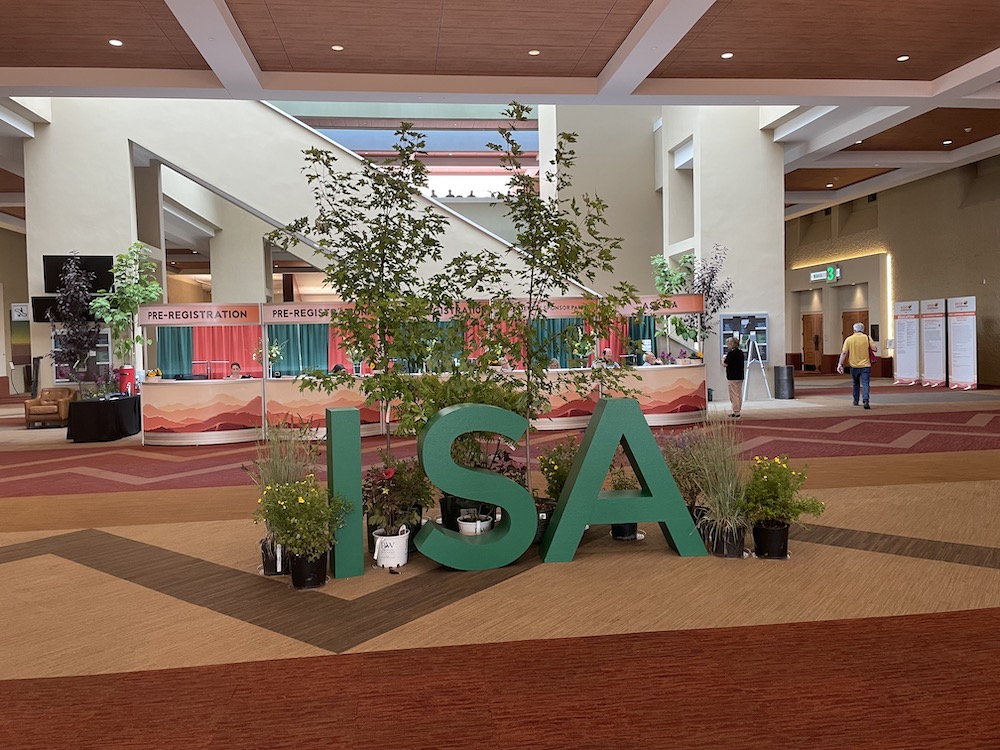
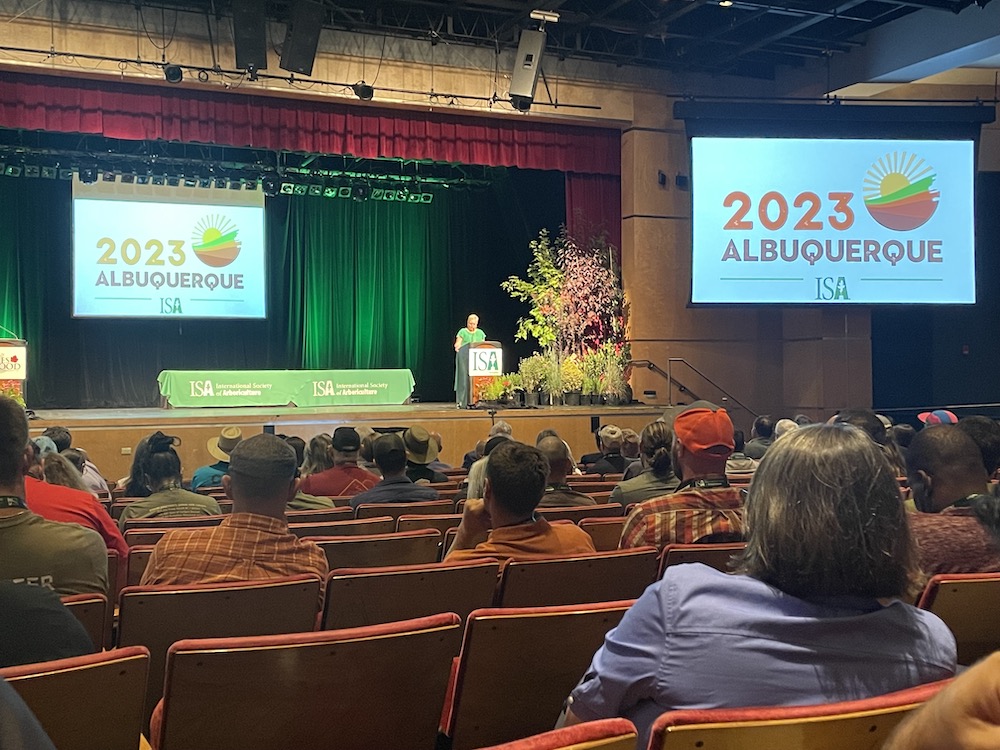
This brings us to the present. The 2023 ISA International Conference in Albuquerque, New Mexico just ended a couple of days ago where about 700 plus arborists from some 20 countries gathered for several days of 8 AM until 9 PM total immersion in all matters tree-related. Every tree care conference we attend is a literal tree-lover’s oasis — a who’s who in the world of tree care from top scientists, industry leaders, the CEOs of professional organizations, arborists, and world-renowned educators. This year was no exception. My son Jared and I attended many classes and workshops during our rendezvous in Albuquerque with other tree geeks. We came away with our heads bursting with new ideas and the latest scientific information to help us to be better craftsman arborists.
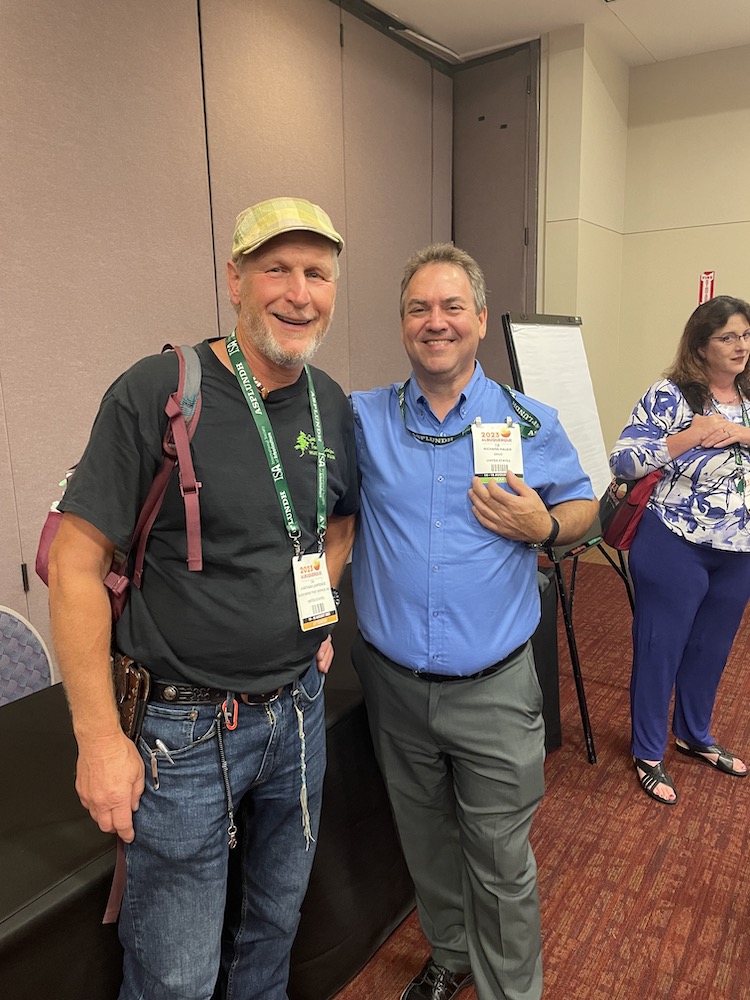
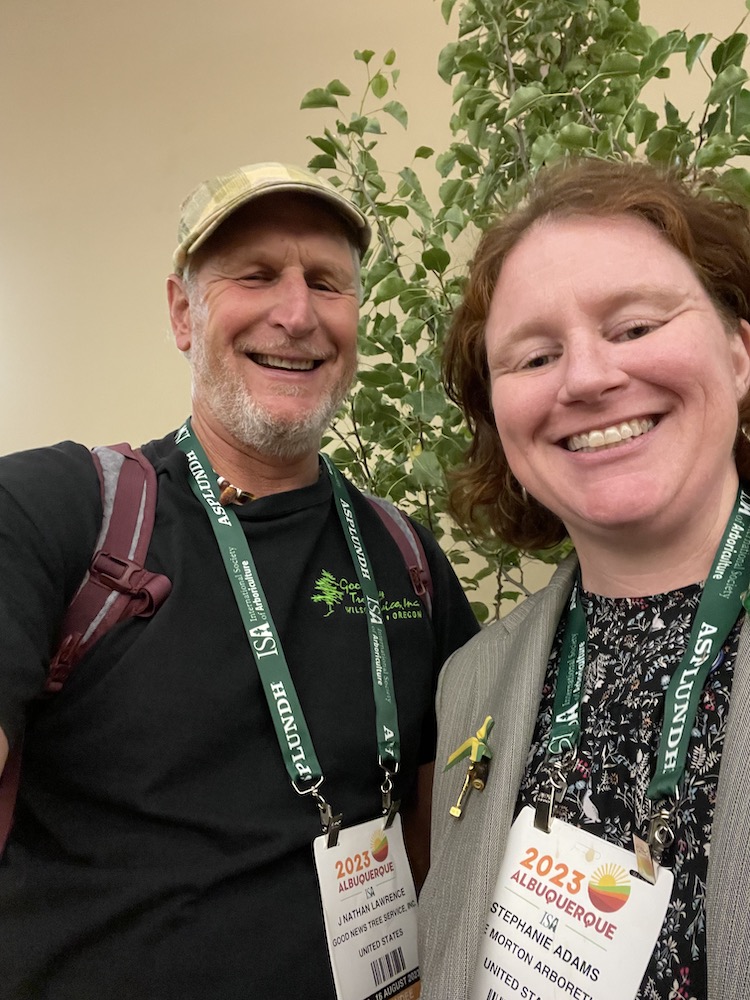
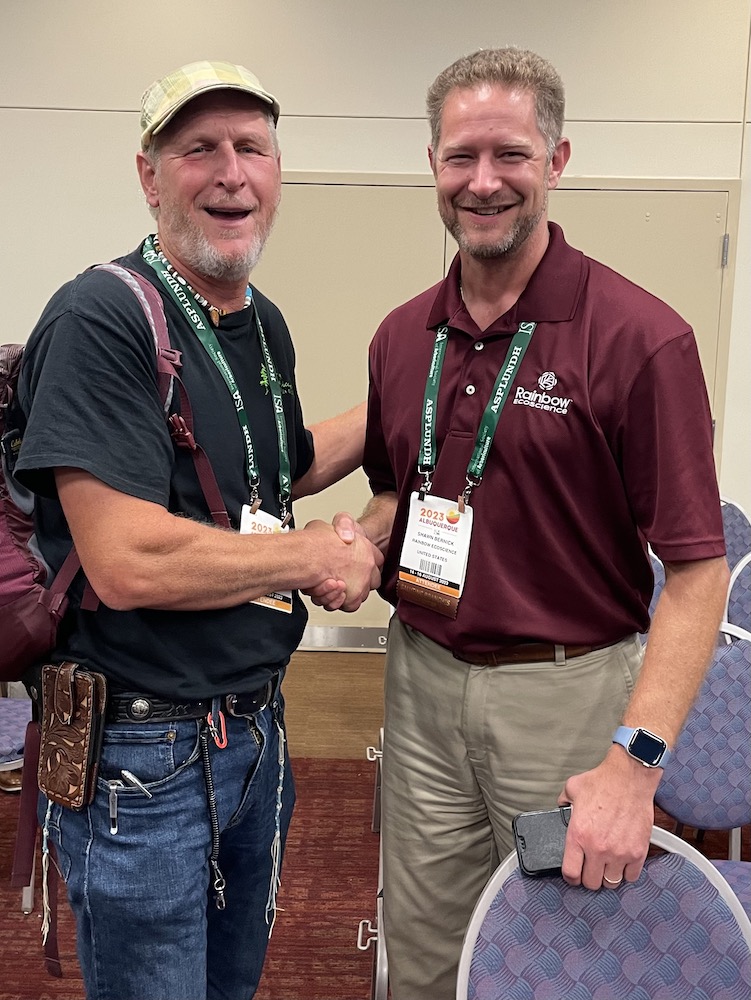
Here are are just a few of the people we hung out with and learned from at this year’s ISA conference:
Dr. Richard Hauer, professor emeritus of urban and community forestry at the University of Wisconsin, Stevens Point, is a leading expert on the invasive emerald ash borer among a plethora of other tree related subjects. Nathan and Jared have attended many of Rich’s lectures at three recent conferences.
Dr. Stephanie Adams, plant health care expert at the nationally renown Morton Arboretum in Lisle, Illinois, has taught Nathan and Jared about tree roots, plant pathology and tree health care at a couple of conferences in the last year. She has provided Nathan and many others with valuable information to help us become better arborist. Thank you Stephanie!
Shawn Bernick is the COO of Rainbow Ecoscience at Minnetonka, Minnesota which is a supplier of some of Good News Tree Service’s plant health care products and equipment. Shawn has provided Nathan with valuable technical info on choosing the right products and equipment in our tree care business. Our thanks goes out to Shawn and to Alison Herrell, Rainbow’s local rep, for their excellent customer service.
Next year, Nathan and Jared plan to be in Atlanta, Georgia, for the ISA’s international conference as it celebrates its 100th anniversary as the world’s leading arboricultural professional organization. Nathan is planning to be one of the speakers at that conference.
Do you have an over-mature landscape that you’re not sure what to do with? Rip it out or repurpose it? How about gradually transforming it into a Japanese style garden? In this video, we encountered a sixty plus year old landscape that has been neglected for years, and we accepted the challenge of refurbishing some very large, old shrubs by pruning them in a Japanese style. From this auspicious beginning, the ecstatic homeowner is planning to add more Japanese-themed aspects (like pines and a moss garden) into the existing landscape to create her dream garden.
Believe it or not, Rome, Italy, has a Japanese Garden designed by a renown Japanese landscape architect and professor. I know, because I was there, and now want to share with you this quiet oasis and precious Japanese gem in the middle of one of Europe’s busiest and noisiest cities. Please join me on this fascinating tour as east meets west in the Japanese Garden of Rome.
The Rome, Italy, Botanical Garden is perhaps Europe’s oldest with the original garden planted in the 1200s. For five Euros admission, one can experience more than a dozen gardens and plant collections in one site including a Japanese garden, a butterfly garden, cactus gardens and greenhouses, a French greenhouse, a conifer garden, a fern garden, a bamboo garden, a rose garden, a Mediterranean garden, an herb garden, a flower garden, a palm tree collection, a grape vine collection, a tropical greenhouse plus numerous fountains and other features dating back to the 1700s. Also see perhaps the largest palm tree in Europe. For plant lovers, this garden is a must-see attraction and is a welcome and quiet oasis in an otherwise busy and noisy city. We ended our five day visit to Rome in this garden—a high point of our trip to this amazing city. Check it out!